
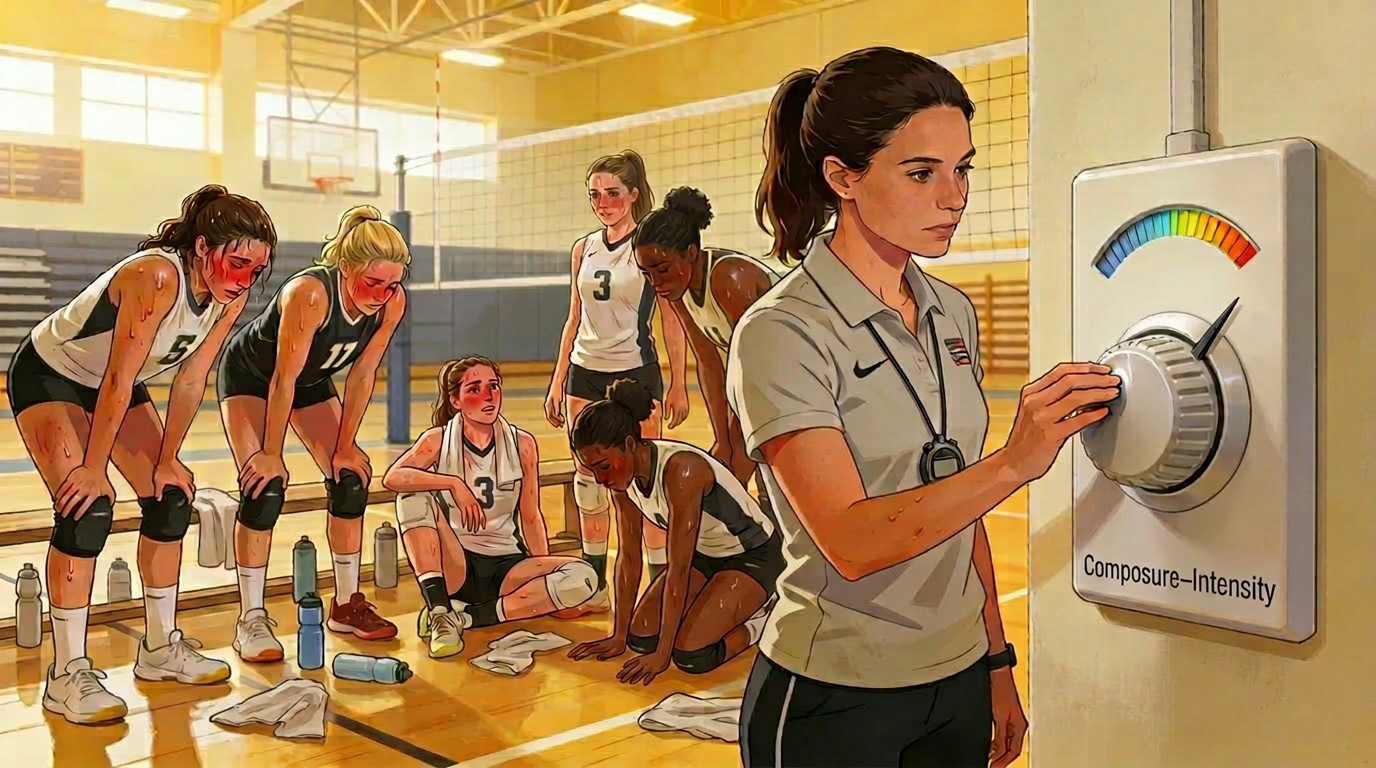
Whether consciously or not, every coach selects the setpoint of the composure-to-intensity thermostat for their team. No team operates at peak levels of both composure and intensity at the same time; they pull in opposite directions. That’s why the thermostat metaphor fits so well: you can’t have a constantly heated, high-intensity team culture and expect players to stay cool under pressure, just as you can’t expect a calm, composed team to suddenly crank up to full intensity just because a big game appears on the schedule.
The 0-10 Composure–Intensity Scale
Picture a scale from 0 to 10, where 0 represents total composure and 10 represents full-throttle intensity. While it might seem logical to aim for a balanced “5,” trying to lean heavily into both traits at once creates confusion on the team’s identity. Instead, it’s best to choose one side of the scale as your primary anchor—based on the developmental level of your players and what they can emotionally and physically handle.
While I won’t assign specific thermostat ranges to certain age groups or athletic ability levels in this posting (look for Part II later for that), I will note that many coaches in team sports tend to operate a couple notches too high in intensity for their athletes’ emotional and developmental readiness. Coaches need to be prepared to dial back their intensity when it doesn’t fit with the athletes they are coaching.
Never Crank the Thermostat Too Quickly
The thermostat quietly shapes team identity, even if it’s rarely discussed outright. Teams perform best when expectations and identity are mindfully constructed and adjusted slowly throughout the season. After your thermostat is set early in the year—when goals and values are defined—it becomes tough to move it more than one notch at a time without unsettling your group. Sudden jumps in midseason tend to rattle athletes and spike unforced errors.
If you’re usually a composed coach who suddenly starts yelling after a few bad plays in a big game, players will likely tighten up instead of refocusing. Conversely, if an intense coach suddenly goes quiet, players often interpret that as disinterest, disappointment, or panic. Teams can’t jump (or drop) multiple thermostat levels in the middle of a season. Small, intentional adjustments work; sharp climate shifts do not.
All-in Composure or Intensity?
Though the thermostat ranges from 0 to 10, extremes rarely produce optimal performance. Operating in the 0–1 range limits your ability to stretch athletes outside their comfort zone, which is essential for growth and competitive toughness. Operating in the 9–10 range, on the other hand, breeds burnout, injuries, and emotional volatility, and most athletes cannot sustain that level of tension for an entire season. Strong and resilient team culture lives somewhere in the 2-8 range—not purely driven by the coach’s preferences, but matched to the players’ emotional and physical readiness.
Adjusting My Thermostat to Fit My College Team
I’m naturally a composure-oriented coach, and my college women’s soccer team reflects that in our composure on and off the pitch. My natural thermostat setpoint sits at 3.5, where calmness, control, and thoughtfulness guide most interactions. But that doesn’t mean it’s always the right setting for my team—in fact, 3.5 is rarely our live thermostat setting during a season.
In my first three seasons building the PCC women’s program, our team thermostat stayed scarily low for a college team, around 2: calm, controlled, and rarely intense. As a new college head coach, that was difficult as my competitive instincts constantly told me to push harder and crank things up. But restraint paid off. Those first few years gave us time to grow, learn, and develop confidence without burning our players out or increasing injury rates, and we made steady progress and reached the playoffs during our last two years despite our meager roster. Was maintaining a low thermostat setting for several YEARS easy? NO, but it was worth it for the future of our program and the mental and physical health of our players.
Now it’s time for us to dial up the heat a bit. With a current roster of hardworking college athletes and incoming recruits who’ve spent the offseason training intensely, our thermostat needs to run hotter so that their effort and competitiveness transfer effectively into practice and games. I anticipate starting our next season around a 4—high enough for training competitiveness while still grounded in building consistency. The reason I’m not sure about our exact thermostat setting to begin this year is that our leadership committee (8-10 players) will have a say on the initial setting based on what they think is best for the team.
Matching the Scale to the Season
Your thermostat shouldn’t stay fixed; it should always adjust with the needs of the team and the rhythm of the season.
Regular season:
Teams in the thermostat range of 3–4 range often find rhythm and consistency. This stage is about learning, stability, and steady growth. Some competitive coaches, however, struggle to tone their thermostat down below a 6, and if that’s you, it may mean your regular season feels less stable, but your high energy can pay off later when the natural intensity of the schedule rises.
Postseason:
Playoff time brings unavoidable pressure and emotional edge. Most successful playoff teams operate their thermostats around 6–7—where focus and urgency fuel peak performance without tipping into chaos. While composed teams can and do win championships, squads more accustomed to higher intensity handle “win-or-go-home” moments more successfully because that emotional energy is familiar instead of overwhelming. Therefore, slowly dialing up your team’s thermostat at the end of the year can help prepare your team for the playoffs.
Team Culture Connection
In conclusion, team culture isn’t built on motivational quotes or locker room slogans—it’s built on emotional awareness and intentional leadership. The composure–intensity thermostat is one of the most practical tools a coach can use to define team identity and model emotional balance in front of their athletes. Understanding your natural thermostat setpoint—and learning to adjust with intention—can make the difference between a good season and one that lasts a lifetime.
Stay tuned for Part Two, where I’ll share practical strategies to help you analyze and fine-tune your team’s ideal composure–intensity thermostat.
Questions for Coaches (please comment below)
- So, where does your current team fall on the composure-to-intensity scale?
- How might your team perform better if your thermostat was adjusted upward or downward one notch?
Leave a Reply